

On Tuesday, in what has become a tediously familiar pattern, Ireland’s media regulator, Coimisiún na Meán, decided “not to proceed further” with two official complaints lodged by the Pro Life Campaign and others over two recent RTÉ programmes that adopted a completely biased and one-sided approach to abortion.
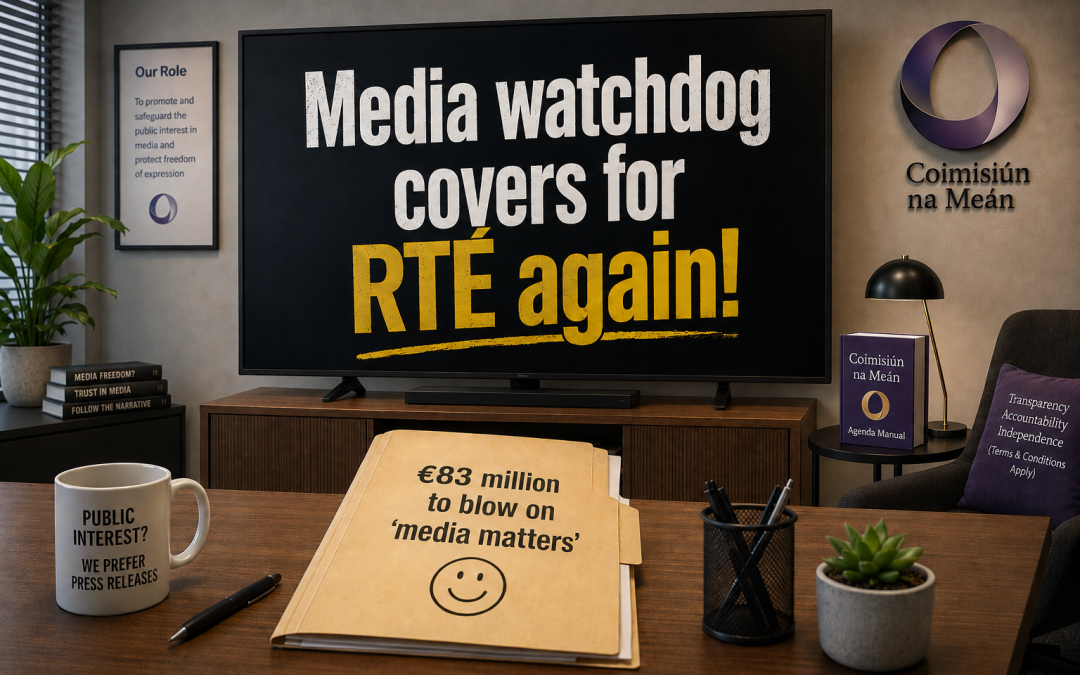
This is the same Coimisiún na Meán that has dispersed a whopping €83.1 million in funding to media outlets over the past four years. Much of that money has gone towards supporting “news and current affairs” programming – the very programming Coimisiún na Meán is then charged with overseeing to ensure editorial fairness and balance.
The serious conflict of interest involved in acting as both funder and regulator is something that could only be waved through in Ireland, such are the impoverished, rock-bottom media standards now operating in this country.
The two programmes given a clean bill of health this week were a Scannal feature broadcast on RTÉ television on both 13 and 20 April 2026, and The Week in Politics, which aired on the same channel on Sunday, 17 May 2026.
Among other things, Scannal focussed on the tragic case of Savita Halappanavar, rehashing the same points that were comprehensively debunked by evidence presented at the Coroner’s Inquest into her death. One of the issues raised in the PLC’s complaint was the failure to give our spokesperson, Eilís Mulroy, a proper opportunity on the programme to present the counterarguments to those pushing for abortion.
Likewise, The Week in Politics dealt with the issue of “Fatal Foetal Abnormality” in a way that created the false and misleading impression that Ireland’s abortion law is still somehow restrictive – something that couldn’t be further from the truth. The programme interviewed a panel made up solely of pro-abortion Oireachtas members and never bothered to seek a pro-life perspective.
None of this, it seems, concerns our taxpayer-funded media regulator in the least. Since its inception, Coimisiún na Meán has a one hundred percent record of finding in favour of biased programmes on abortion.
At the same time, it waxes lyrical about misinformation and seeks to use its powers to constrain others, while taking a highly selective approach to what counts as misinformation and deciding what types of news and information, in its eyes, the public should and shouldn’t have access to.
It is hard to think of a bigger scandal in Ireland today than the operation of Coimisiún na Meán. It is one of the clearest examples of everything that has gone awry – and of what now requires strong political resolve to push back against, leading to a fundamental reappraisal of the mechanisms by which fairness in the media is upheld.
The one-sided reporting in both programmes, Scanall and The Week in Politics concerns me greatly.
Comisiun na Mean is supposed to be unpredicted and is funded by All tax-payers, including me.
Coimisiun na Mean is the creation of a controlling government. It is fulfilling its role in promotion of government policy and in suffocating any criticism of it. Like many other NGOs it is funded by us, the taxpayers, to pursue minority interests which are contrary to the interests of the majority. There does not seem to be any way we can prevent our tax revenue from being used against us.
Correction: Commission na Mean is supposed to be unprejudiced
That’s the society we live-in – where the lowest common denominator prevails and contaminates all /most fields of activity.
Ireland has now been conditioned to treat such abominations as ‘eaten bread’, so await the agitation for the next installment to intensify.
Finally, I wouldn’t expect much from an organisation with such a clumsy name
There is something rotten at the core of Irish life.
If Ireland is a democracy, as some people pretend it is, then it is crucial that all voices be heard, not just the voice of those who who toe the line of Liberal Fundamentalism (LF). , (LF is a sort of crackpot liberalism that has unlimited tolerance for purveyors of all kinds of aberrant, non-researched non-scientific, non-natural, nonsense).
One of the stories in The Odyssey, a film of which which is in the news recently, is the Cyclops episode; having only one eye, he lacks vision with which to see the world in its entirety. Those of the LF- Cyclopean persuasion, lacking any breadth of vision, are, like anarchists, keen to destroy a culture that has been carefully nurtured over centuries