

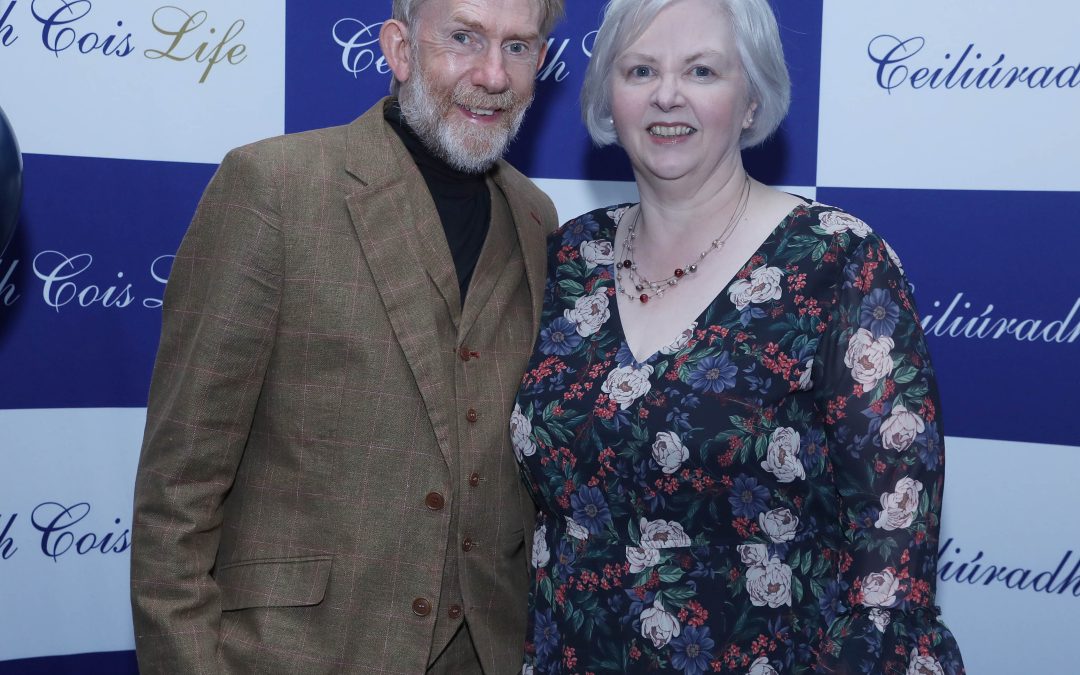
Take a few minutes to read Breda O’Brien’s marvellous keynote address from last weekend’s pro-life dinner in Dublin.
Eilís Mulroy summed it up on the night: this is an address that deserves to be read and read again by pro-life supporters.
Breda O’Brien’s keynote address in full
Delivered at Ceiliúradh Cois Life, the Pro Life Campaign’s annual dinner, at the Burlington Hotel, Dublin.
A room full of people who hold firm
Good evening, my lord bishops, senators, councillors, reverend clergy, a chairde.
I am beyond delighted to be here, not least because I want to enjoy the sensation of being in a room with 620 people who agree with me about equal human rights. It doesn’t happen that often, so I suggest that we all revel in it, look around and rejoice that so many fine people of all ages still hold firmly to their convictions. It is good for us to be here. I hope you agree?
I am sure that many of you, like me, are deeply troubled by events since the Repeal of the life-saving 8th Amendment. We should be both horrified by the cumulative total of more than 60,000 abortions and thankful that the numbers dropped by a small amount last year.
If we are shell-shocked in Ireland, it is hard to imagine how people in the US feel. Rolling back Roe v. Wade was a huge goal for pro-life people for so long, and the rejoicing was real when it happened.
How does culture actually change?
But I was reading recently about David Bereit, founder of the 40 Days for Life advocacy group. He almost quit when he realised that abortion figures had not fallen since the Dobbs judgement but instead had risen by 21 per cent.
He was devastated. Then, as he explained at an ADF conference, someone asked him a provocative question. How does culture actually change?
He first had to define culture and his definition is deceptively simple.
“Culture is not what a nation debates; culture is what a nation assumes.”
It is the things that people assume are normal, that are part of the air we breathe.
David Bereit did a deep dive into more than 30 huge cultural changes over the past 100 years in the US, both positive and negative, from driving with drink taken to smoking tobacco to much more. He found that culture changes when people’s assumptions change, and this happens in three stages.
Incubation: a small, very committed group of people come together to formulate ideas. They discuss how to get them out and start gaining footholds in important institutions like government, political parties and the media. This can take 10 to 30 years.
Acceleration: some tipping point happens and the process speeds up, which can take 5 to 10 years. Ideas become mainstream, they begin to become part of what is taught in schools, in entertainment and in media. One of his surprising findings was that behaviour often changes first before beliefs follow.
Lock-in: law, education, professional standards, and economic incentives reinforce what society has begun to normalise. It simply becomes received wisdom.
He uses the metaphor of a stream. You only keep legislatively downstream what you cultivate upstream in the culture.
A four-cornered strategy
Equal Rights Institute president, Greg Austen, develops this further into what he calls a four-cornered strategy.
Just laws: these are essential, but become very fragile if not supported by culture.
Changed hearts: the aim is to render abortion not just illegal but unthinkable. Just as slavery became unthinkable, even though it was a pillar of economies across Europe and the US.
Integrity: this incorporates civility and character, the way we conduct ourselves and the people we are. We must be, as far as possible for flawed humans, impeccable in the way we conduct ourselves.
Human flourishing: an expansive vision of what humans need to flourish, a womb-to-tomb concern for human beings.
So many reasons for hope
This is a challenging vision but people are working on it, right here, right now. Rehumanise International now has an Irish chapter. It is important that some groups are single issue, and that some are anti-violence in all arenas, including unjust war.
There were two significant political victories this year, of the People Before Profit and Social Democrats’ bills. That did not happen by itself but because of sterling work by the PLC.
When it comes to practical support for women who want to continue a pregnancy, it is pro-life people who step up to the mark. It is Community Connect and Gianna Care, not pro-choice organisations.
When it comes to the voices of women who regret their abortions, or who chose to give birth because of the three-day wait, or who chose to carry a baby to term despite a terrifying diagnosis of a life-limiting condition, those women are heard and amplified by pro-life organisations. It is almost as if they are invisible otherwise. All women are equal, apparently, but some are more equal than others.
It is great to see so many young people here this evening. It is particularly great to see the Future Leaders.
There are so many reasons for hope. Cultures change all the time, sometimes dramatically.
Erich Honecker, the hardline dictator of East Germany, boasted in January 1989 that the Berlin Wall would stand for 50 or a hundred years. Instead, he was ousted in October 1989 and the wall fell a month later.
Culture changes one conversation at a time
Our greatest hope to change culture is through conversations, one person at a time. May I make a confession? I would sooner go on Prime Time, or even, God help us, travel back through time to be interviewed by Vincent Browne, than talk to my pro-choice neighbour about her views. And yet I know that culture changes one conversation at a time.
There are so many resources available to help us, though, so there is no reason for my cowardice. There are the seminars run by the PLC, including by the lovely Wendy Grace, this week.
If I could just be a proud Mama for a moment, I would like to point out the excellent work done by The Minimise Project by my son Ben Conroy and a lot of other people I did not actually give birth to, including the wonderful Muireann Lynch and Cian Flaherty, to name but two.
The Minimise Project exists to change people’s minds about abortion through respectful dialogue and conversation, and to promote policies and new ideas to reduce the abortion rate.
The equal rights argument
I think one of the key insights of the Minimise Project is that the abortion argument is actually two different arguments, one about the equal human rights of human beings before and after birth, and the other about bodily autonomy. I think people who are pro-life instinctively feel that if we can get people to accept the humanity of the unborn child, the argument is over. This just is not the case.
The trouble is that a lot of people say well, yeah, sure they are biologically human, but that doesn’t mean that they actually have equal human rights.
So we have to do a lot of work to try and convince people that basing equality on anything other than the simple fact of being human does not work. For example, if you base it on intellectual abilities, it’s going to exclude people with radical cognitive difficulties from human rights. If you are basing human rights on consciousness, you exclude coma patients. Arguably, it also excludes young babies, who only have the most rudimentary sense that they are separate from their mothers for months on end. If you base it on sentience, it may include squirrels and certainly includes cats.
That kind of argument, convincing people that none of the other bases for human rights really works other than being a member of the human species, is called the equal rights argument. There are wonderful resources to help us understand how to articulate that argument, including from Rehumanise International and the Equal Rights Institute, and of course, the Minimise Project. It is absolutely something we all need a sophisticated grasp of, along with an ability to counteract arguments that say the embryo or foetus is human but not a human-rights bearer.
Understanding bodily autonomy
The big problem, however, is that this is just half of the argument. The other part is what they are always telling us it is: bodily autonomy for women. For us, it is almost inconceivable that a person could agree that the unborn is a child, or a human being with full dignity, and still say that a woman’s right to bodily autonomy overrides that. But that is precisely the thing a lot of pro-choice people believe. They believe it for good reasons, because bodily autonomy is an important value. If we want to change people’s minds on that, and have successful conversations with people with whom we do not agree, we have to really understand where they are coming from, and that will increase our confidence.
Pregnancy is a demanding physical state. You are growing a whole human being. If you are doing something demanding, and you feel forced into it, it is normally considered an abuse of your human rights. No one can force you to donate a kidney, for example, no matter how worthy the recipient.
So we cannot just say it is just nine months. Pregnancy alters a woman forever in so many different ways. There is nothing else that is quite like the state of pregnancy. I was always instinctively pro-life but when I came across a leaflet called Feminists for Life of Canada, in the wonderful Brendan Shortall’s office, that linked women’s rights and the rights of the unborn, it gave me a way of presenting the message that for me, personally, was life-changing.
Building human connections
When it comes to these kinds of conversations, we are not trying to show people how clever we are or defeat their arguments. We are carefully, cautiously trying to build human connections, acknowledging that in the current state of our culture our views will appear very weird, and trying to persuade, not hit people over the head with a mallet.
“People will forget what you said. People will forget what you did. But people will never forget how you made them feel.”
That old saying is often attributed to Maya Angelou. It doesn’t matter whether she said it or not, it is still true.
If we are to begin the slow process of changing culture, and making abortion unthinkable, it begins with conversations. So I should get off this stage and let you all have your own conversations. Go raibh maith agaibh go léir.
Join the Minimise Project’s upcoming workshop
In her address, Breda spoke about the Minimise Project, which exists to change people’s minds about abortion through respectful dialogue and conversation, and to promote policies and new ideas to reduce the abortion rate.
If her words struck a chord, you can sign up for their upcoming workshop or read more about their work on their Substack.