

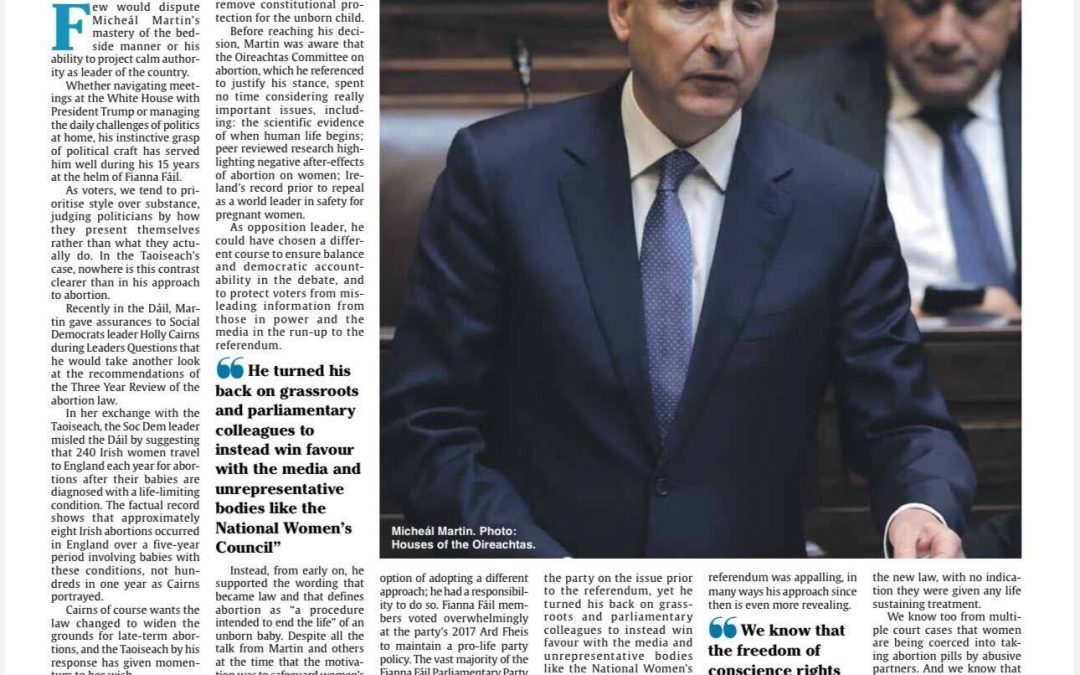
Micheál Martin is often praised for his calm and composed leadership, but his record on abortion tells a very different story. In an article in last week’s The Irish Catholic, Eilís Mulroy examines how Martin’s political decisions—especially around the 2018 referendum and the current abortion law—contrast sharply with the public image he projects.
Few would dispute Micheál Martin’s mastery of the bedside manner or his ability to project calm authority as leader of the country.
Whether navigating meetings at the White House with President Trump or managing the daily challenges of politics at home, his instinctive grasp of political craft has served him well during his 15 years at the helm of Fianna Fáil.
As voters, we tend to prioritise style over substance, judging politicians by how they present themselves rather than what they actually do. In the Taoiseach’s case, nowhere is this contrast clearer than in his approach to abortion.
Recently in the Dáil, Martin gave assurances to Social Democrats leader Holly Cairns during Leaders Questions that he would take another look at the recommendations of the Three Year Review of the abortion law.
In her exchange with the Taoiseach, the Soc Dem leader misled the Dáil by suggesting that 240 Irish women travel to England each year for abortions after their babies are diagnosed with a life-limiting condition. The factual record shows that approximately eight Irish abortions occurred in England over a five-year period involving babies with these conditions, not hundreds in one year as Cairns portrayed.
Cairns of course wants the law changed to widen the grounds for late-term abortions, and the Taoiseach by his response has given momentum to her wish.
Disquieting
It’s disquieting the speed with which he moves to appease pro-abortion voices, while serious concerns raised about, say, the massive rise in abortions in Ireland are met with total indifference from him.
Before the 2018 abortion referendum, as leader of the opposition, he adopted the politically expedient position of backing the Fine Gael-led government’s proposal to dismantle the Eighth Amendment and remove constitutional protection for the unborn child.
Before reaching his decision, Martin was aware that the Oireachtas Committee on abortion, which he referenced to justify his stance, spent no time considering really important issues, including: the scientific evidence of when human life begins; peer reviewed research highlighting negative after-effects of abortion on women; Ireland’s record prior to repeal as a world leader in safety for pregnant women.
As opposition leader, he could have chosen a different course to ensure balance and democratic accountability in the debate, and to protect voters from misleading information from those in power and the media in the run-up to the referendum.
He turned his back on grassroots and parliamentary colleagues to instead win favour with the media and unrepresentative bodies like the National Women’s Council”
Instead, from early on, he supported the wording that became law and that defines abortion as “a procedure intended to end the life” of an unborn baby. Despite all the talk from Martin and others at the time that the motivation was to safeguard women’s health, the abortion law as it stands has nothing to do with genuine healthcare and everything to do with facilitating the taking of innocent human life.
As Fianna Fáil leader in 2018, Martin not only had the option of adopting a different approach; he had a responsibility to do so. Fianna Fáil members voted overwhelmingly at the party’s 2017 Ard Fheis to maintain a pro-life party policy. The vast majority of the Fianna Fáil Parliamentary Party backed the same position. Exit polls on the day of the referendum also revealed that a majority of Fianna Fáil voters nationwide voted No.
Martin was aware of the strength of feeling within the party on the issue prior to the referendum, yet he turned his back on grassroots and parliamentary colleagues to instead win favour with the media and unrepresentative bodies like the National Women’s Council.
Benefited
While he may have benefited politically from embracing abortion, the same cannot be said for his party. Votes that Fianna Fáil once had securely are now switching to Aontú, Independent Ireland and Independents due to the feeling of betrayal among pro-life voters.
Pro-life supporters still appreciate the Fianna Fáil Oireachtas members who vote pro-life but the damage Martin has done to the party’s image across the country is hard to overstate.
While his stance during the referendum was appalling, in many ways his approach since then is even more revealing.
We know that the freedom of conscience rights of young doctors who do not wish to facilitate abortions are not being respected”
Since the new law took effect, the annual number of abortions has risen from 2,879 in 2018 to 10,852 for the last recorded 12-month period. The government currently has no policy aimed at reducing abortion numbers.
We know from Parliamentary Questions that over 100 babies have been born alive after “failed abortions” under the new law, with no indication they were given any life sustaining treatment.
We know too from multiple court cases that women are being coerced into taking abortion pills by abusive partners. And we know that the freedom of conscience rights of young doctors who do not wish to facilitate abortions are not being respected.
Deafening
The Taoiseach’s response to all this has been a deafening silence. Yet he is very forthcoming when asked about expanding access to abortion. You’d like to think he might reconsider his approach to the issue, but nothing currently supports that hope.
Micheál Martin’s bedside manner may have served him well politically but the same cannot be said for an incalculable number of unborn babies and their mothers
As a former Fianna Fail supporter i now support Aontu because of this about turn of Mickey Martin.
In a democracy the electorate is ultimately responsible for the actions of its chosen government. In consequence surely criticism of bad actions by its chosen government surely should focus more on us the electorate than on the chosen representatives?
It was stated here that Fianna Fail members at the 2017 Ard Fheis voted overwhelmingly to remain a pro-life party and his Parliamentary party agreed also. So how do you deal with a party leader, who betrays his obligations AFTER he is democratically elected by the people ?
I too was disgusted with Micheal Martins change of stance at the time of the referendum. I was also horrified at Simon Harris arrogant stance leading the campaign as Health Minister. Peadar Tóibín performed extremely well against him in the debate. Dissapointing that Aontú have only two Tds in the Dáil i use the ballot paper to vote for prolife candidates and continue my vote down the line for the least objectionable candidates after that.
I too was disgusted with Micheal Martins change of stance at the time of the referendum. I was also horrified at Simon Harris arrogant stance leading the campaign as Health Minister. Peadar Tóibín performed extremely well against him in the debate. Dissapointing that Aontú have only two Tds in the Dáil i use the ballot paper to vote for prolife candidates and continue my vote down the line for the least objectionable candidates after that.
I was disgusted with the stance Michael Martin took on the repeal amendment. I am voting Aontu since Peader Toibin set it up!! Our government should hang their heads in shame!
The Abortion Act 2018 legalises murder. It legalises the intentional killing of unwanted babies before and after birth. It forces doctors to commit murder. Silent protest outside killing stations is banned. If you pray in silence outside an abortion centre, you will be sent to the Gulag, The socialists are screaming for more killing. They are ravenous for more blood. They will will never be sated.
Well said
A brilliant eye opener about Martin. Thank you.
Thank you for highlighting this. I will never forget how Micheal Martin’s intervention prior to the 2018 referendum was a critical factor in swinging thigs to the “yes” side. Shame on him!
Great article Eilís! Indeed, it’s true that we often judge politicians on the public image they project rather than on their political decisions, but this article really shows what a mistake that is.
Michael Martin stood with FG and others in their support of abortion so that they wouldn’t stand in his way to become Taoiseach. He basically sold his soul to the devil for his political career.
Willfully n knowingly taking of the life of an unborn child should be called what it is but murder.
Can it be contested in the courts??
A pregnant woman should be financially n emotionally protected from when she finds that she has conceived . From day one, not having to wait until the baby is born.
Tusla should be reformed
Well said- Michael Martin not supporting the pro life stance at all. There should be balance in any debate. There is no balance at all, in fact there is imbalance because pro abortion groups are funded by gov using tax payers money, yet pro-life do not get an equal funding. Also the review judge did not speak to women who availed of the 3 day cooling off period, so how can it be a balanced report. Both sides of any moral debate should be listened to, however this is not the case here and Michael Martin is saying little and anything he does say favours the pro abortion side of the argument.