

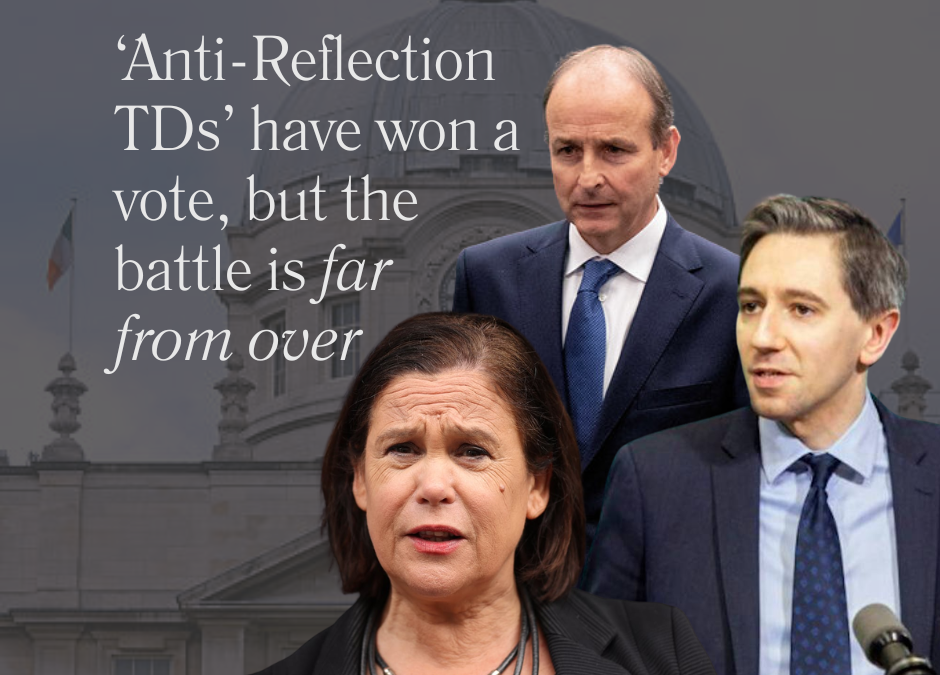
The Dáil’s decision this week to advance Sinn Féin’s bill on the three-day reflection period was a disappointing setback. The measure passed at second stage by 86 votes to 70, but the story behind the numbers is every bit as important as the result itself.
What stood out most throughout this debate was where the pressure for change originated. Unlike previous abortion debates, the loudest push did not come from the media. Instead, it came from some of the most determined pro-abortion voices within the political establishment itself.
Equally striking was Sinn Féin’s reluctance to engage in meaningful public debate on the issue. That reluctance is perhaps understandable given that the only substantive on-air exchange on the subject – between Louise O’Reilly of Sinn Féin and Eilís Mulroy on Newstalk Breakfast – proved distinctly uncomfortable for Sinn Féin.
No two politicians bear greater responsibility for this week’s outcome than Micheál Martin and Simon Harris. Neither man made any attempt to publicly justify their support for removing the three-day wait. Instead, they ensured the deal with Sinn Féin was done behind closed doors and sprung on the public at the last minute. For two men occupying the highest offices in the State, it was an astonishing display of political cynicism.
By backing this bill, Martin and Harris have also turned their backs on the cast-iron guarantees they gave the public in 2018 with regard to the three-day wait. It amounts to a serious breach of trust and one that many voters are unlikely to forget.
We now enter what could prove to be an even sadder and more unsavoury phase of this debate as the bill moves to committee stage. This is where the political choreography is likely to go into overdrive. Having secured the vote in principle, supporters of the bill must now attempt to retrospectively construct a convincing case for why the three-day reflection period should be abolished.
Micheál Martin, Simon Harris, Mary Lou McDonald and the other anti-reflection TDs are acutely aware that something needs to be produced to justify the position they have already taken. That challenge exists because a glaring weakness remains at the heart of their argument. The Chair of the review of Ireland’s abortion law admitted before an Oireachtas committee that she did not consult a single woman from among the thousands who attended a first abortion appointment but chose not to return after the waiting period. It has been a source of embarrassment for supporters of the bill that they have been unable to address this glaring weakness in their argument. Expect renewed efforts to deal with it through carefully selected ‘expert panels’ and taxpayer-funded exercises designed less to discover the truth than to provide political cover.
While it can be very difficult watching these set pieces and political manoeuvres take shape, their utterly galling nature also presents an opportunity. The more obvious the choreography becomes, the easier it is to expose the weakness of the case being made, the contradictions involved, and the profound disregard it shows towards women and their unborn babies.
The pro-life side has strong grounds to be hopeful too. The response to this bill has made it abundantly clear that there is no real appetite for the three-day wait being done away with. If anything, the reverse is true. Members of the public are increasingly asking why so many senior politicians are focused on facilitating more abortions rather than doing the job they were elected to do – running the country.
Those in power who claim to engage with all sides of this debate, but who repeatedly fail to do so, are losing public credibility with each passing day. Even though we lost this vote, some of the best people you could ever hope to meet represent us in the Oireachtas, and the good news is that their numbers are growing with each passing election.
Tremendous credit is due to Aontú, Independent Ireland and the Independent TDs for how they conducted themselves on Wednesday, and also to the members of Fianna Fáil and Fine Gael – including ministers such as Dara Calleary, Jim O’Callaghan, Mary Butler, Martin Heydon and Norma Foley – who voted according to their conscience and against the position taken by their respective party leaders.
When it comes to the three-day wait, the fight is far from over. This week’s vote only takes the bill to committee stage. It is going to take a huge effort to protect it, of that there is no doubt, but we are ready to face that challenge head on.
I emailed the Taoiseach’s office on Tuesday night appealing to his better side, but sadly it fell on deaf ears.
I’ve lost all faith in the party leaders but I am so grateful to people like Carol Nolan, Mary Butler and Jim O Callaghan etc.
I’m utterly disgusted with our leaders; they certainly don’t represented me. I can’t understand why they are so fixated on destroying life.
A very sad day for the unborn. Why not allow mothers the opportunity to change their minds.
Where was the chat with the mothers who did change their minds and get their views. Shame on those TD’s who voted yes.
The unborn are the most vunerable.
This is disgustingly evil… To be for abortion… Murdering babies in their mother’s wombs 😪😪😪 to take away 3 day waiting period is not thinking of 5he women… its about pushing an agenda… Shame in all responsible 😪😪😪 God help all 🙏🙏🙏
Well said.
NoelSmyth.
A very sad day for the unborn. Why not allow mothers the opportunity to change their minds.
Where was the chat with the mothers who did change their minds and get their views. Shame on those TD’s who voted yes. If I was told I needed a procedure I would have to wait even though my health could be affected.
The unborn are the most vunerable.
Exactly! There seems to have been no attempt to chat with those mothers who changed their mind.
This was a deliberate deceit stretching back to 2018. A temporary device used to secure votes at the time. The proponents of the “yes” vote may have “promised” the three-day wait as a sweetener – but it didn’t go into the Constitution, so there was nothing guaranteed about it. It was at the mercy of the politicians of the day and so was always an open goal waiting to be scored.
Shame on all those politicians who have pushed this. Once society accepts the principle of abortion (as it was persuaded to do in 2018) there is no limit to how horrific the situation can become.
At the time it was said Ireland would the Jewel in the Crown… Shame on our so called government… They have to answer to God!
Absolutely repulsive result. How are the interests of the baby, mother or society served? There is no slippery slope here: the soil is fertile for assisted dying.
Yet again, our political leaders have failed to show any backbone or moral courage – the global holocaust of the unborn continues, cheer-led by our so-called leaders … of course they will want to decry the changing demographics at the same time and complain about lack of population to work in our country …
By backing this bill Martin and Harris have turned their backs on the guarantees they gave the public in 2018 with regard to the three day wait.
It was an astonishing display of political cynicism.
16/17 centuary saw the wanten wasting of us Irish To be replaced by the forigners it seems that similar plan is been actioned.
Stop the murder
An eye for an eye??