

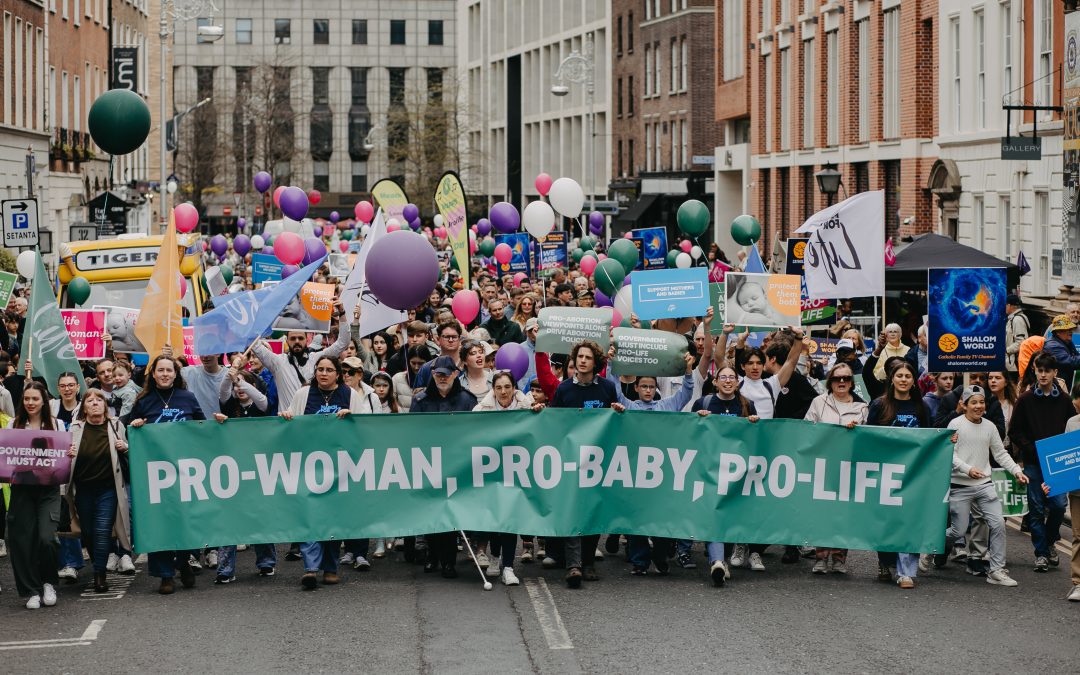
Several thousand people took part in the annual March for Life in Dublin earlier today. The focus of this year’s event was on Ireland’s rapidly rising abortion numbers, contrasting with the Government’s promise in 2018 that abortions would be “rare” if people voted for repeal. Drawing loud cheers from the crowd, the speakers called for a shift in government policy away from promoting abortion and toward prioritising life-affirming supports.
Guest speakers at the march included Ken O’Flynn TD from Independent Ireland and Councillor Ellen Troy of Aontú.
Addressing the crowd in Molesworth Street, Pro Life Campaign spokesperson Eilís Mulroy said: “The numbers tell a very clear story. Since 2018, abortions in Ireland have risen from fewer than 3,000 a year to close to 11,000. It’s hard to believe but today 1 in 6 babies’ lives ends in abortion in this country. This is not what people were promised. Micheál Martin and Simon Harris were leading voices in the 2018 referendum and assured voters abortion would be ‘rare’ if they voted for it. Today, instead of confronting what has followed, they appear content to look the other way. Not only that but the Taoiseach and Tánaiste are doing nothing to push back against those in the Dáil seeking to do away with the life-saving three-day wait and widen the grounds for late-term abortion. Their approach is one of silence and inaction – ignore the numbers, ignore the stories of women who regret their abortions, and hope the issue goes away. But it won’t. Because people are paying attention. Your presence here today, and the numbers at pro-life events across the country, show a movement that is not waning but gaining strength. People want to see a shift away from promoting abortion to prioritising life-affirming supports.”
Ms Mulroy continued: “There is nothing defensible about a situation where the most extreme pro-abortion voices are shaping government policy, while the pro-life viewpoint – which represents a significant part of the population – is excluded entirely. And yet, there is real cause for optimism. Since the 2018 referendum, the number of pro-life TDs and Senators has steadily increased, and there is a growing energy and commitment to dramatically expand that representation next time round.”
In his address, Ken O’Flynn TD, said: “One hundred and eight babies were born alive after abortion procedures in this country between 2019 and 2023. Twenty-nine in one year alone. I know that because I asked the questions. And when I asked what happened next, I was met with silence. That is not accountability. And it is not acceptable.
Regarding the latest moves in the Dáil to remove safeguards such as the three-day waiting period and expand access to abortion, Deputy Flynn said: “In a year when over ten thousand abortions took place, the response from parts of the system is not reflection. It is expansion. But here is the question that matters. Why? Why are women still reaching this point? In a country with our resources, why do so many feel they have no other choice? Is it housing? Is it cost of living? Is it fear? Is it lack of support? Because if those pressures remain, then expanding abortion does not solve the problem. It hides it. And that is where we need to change course.”
Councillor Ellen Troy told those in attendance that “this very week we saw Social Democrats urging supporters to “dig out their Repeal jumpers” as they campaign yet again to remove the three-day waiting period. The media machine is already rolling into action, giving activists endless airtime and almost no challenge. But they never tell the whole story. They never tell the stories of women hurt by abortion. They never tell the stories of women pressured by abusive partners. And they certainly do not tell the story of the more than 10,000 women who changed their minds after the three-day waiting period and chose life. Ten thousand women. Ten thousand second chances. Ten thousand lives saved. Those are not statistics. Those are mothers. Those are babies. Those are families forever changed because someone was given time to pause, reflect and choose life. Yet the chair of the abortion law review admitted she had not even spoken to any of those women. Imagine that. Over 10,000 women changed their minds, and not one was consulted. What kind of review ignores the voices of women who chose life?”
On the issue of coercive abortion, PLC spokesperson Caroline Simons said: “We’re not even halfway through 2026, and already two men have been handed significant prison sentences for coercive forced abortion. The rise in these cases in Ireland is deeply alarming. It demands an urgent, comprehensive government response to assess the scale of the problem and identify measures to end this violence against women and their unborn babies. This issue should already be firmly on the political agenda. Instead, the Government is not only failing to act – it has yet to even acknowledge that there is a problem.”
Emmet Dooley, Director of Education and Outreach for the Society for the Protection of Unborn Children in Scotland, told attendees about how he was ‘pro-choice’ when he was younger and at university, saying: “There is nothing easier than being a pro-choice man – you do nothing offer nothing.”
He said he had “believed the lies in the media that said pro-lifers were extreme” until his own personal encounters showed him that this caricature was far from the truth. He went on to describe the difficulty of explaining what abortion is to one of his young children as the questions kept coming, noting how a child’s natural reaction is to recoil at the very idea of it.